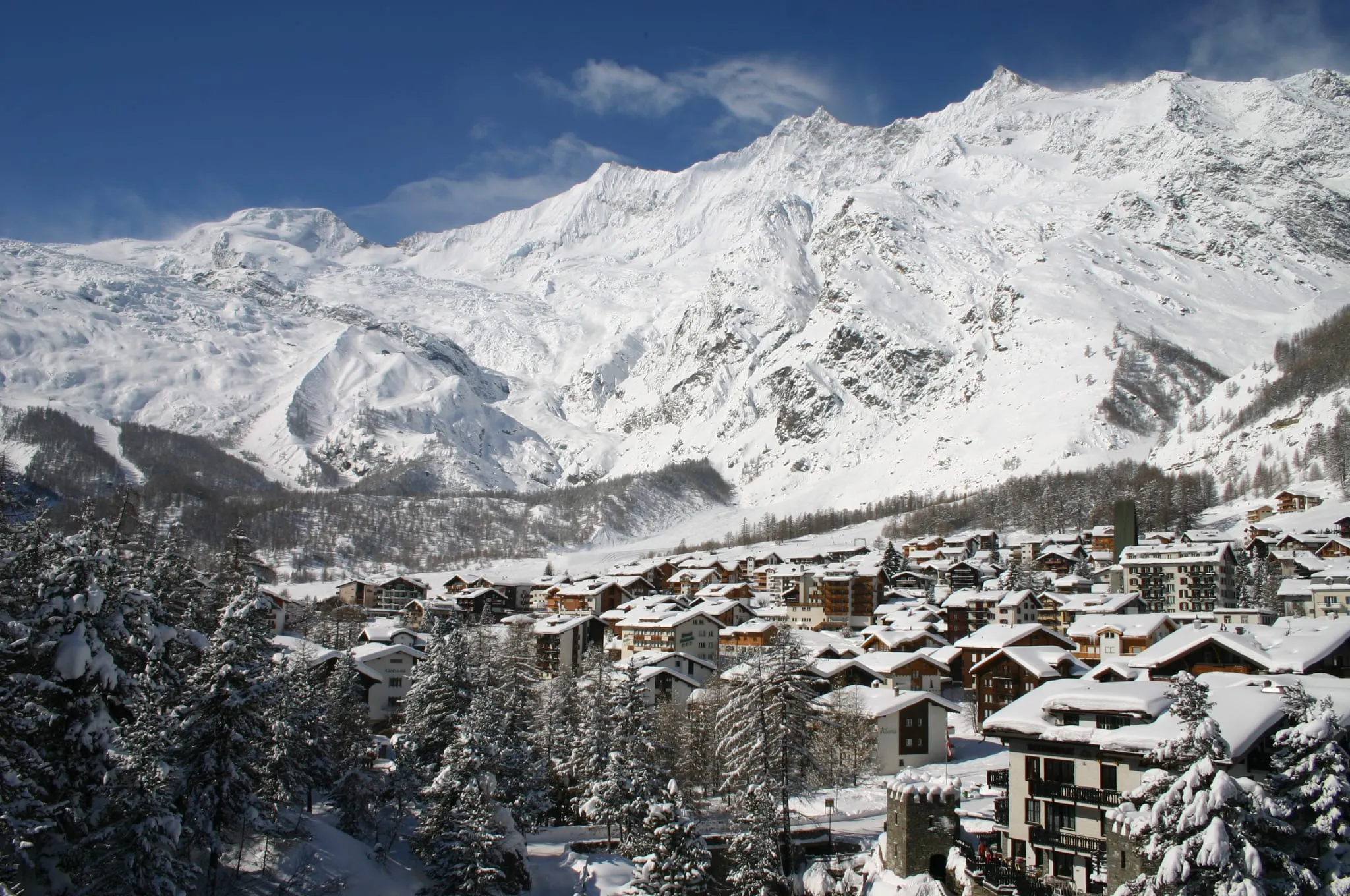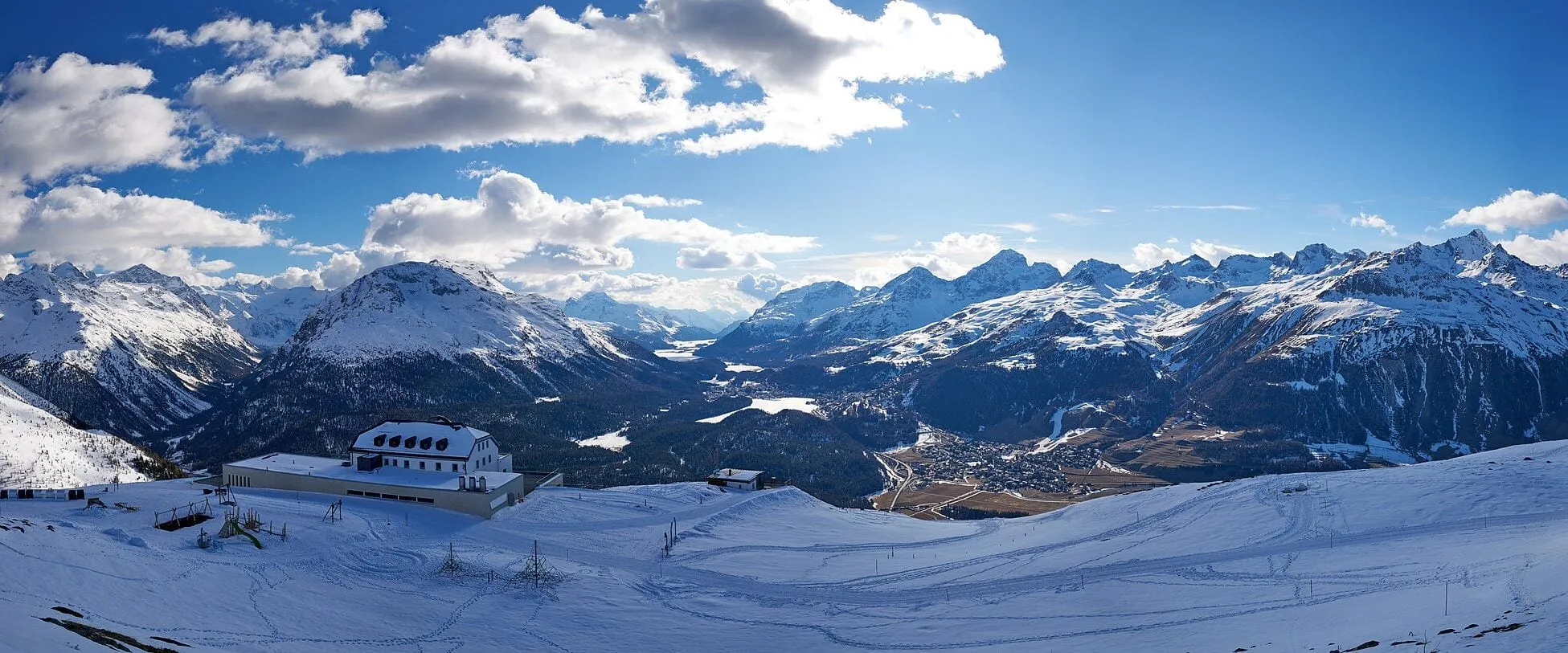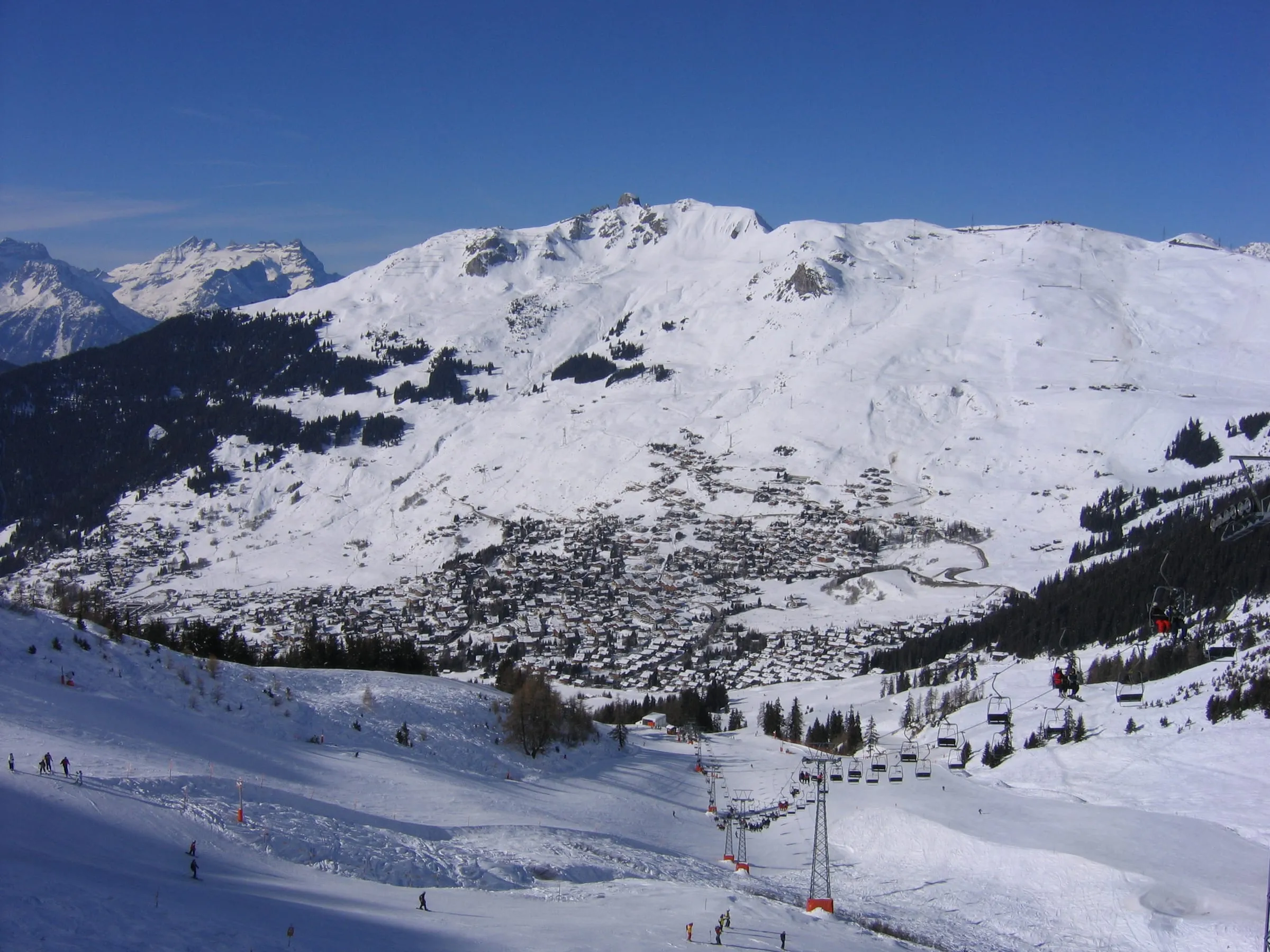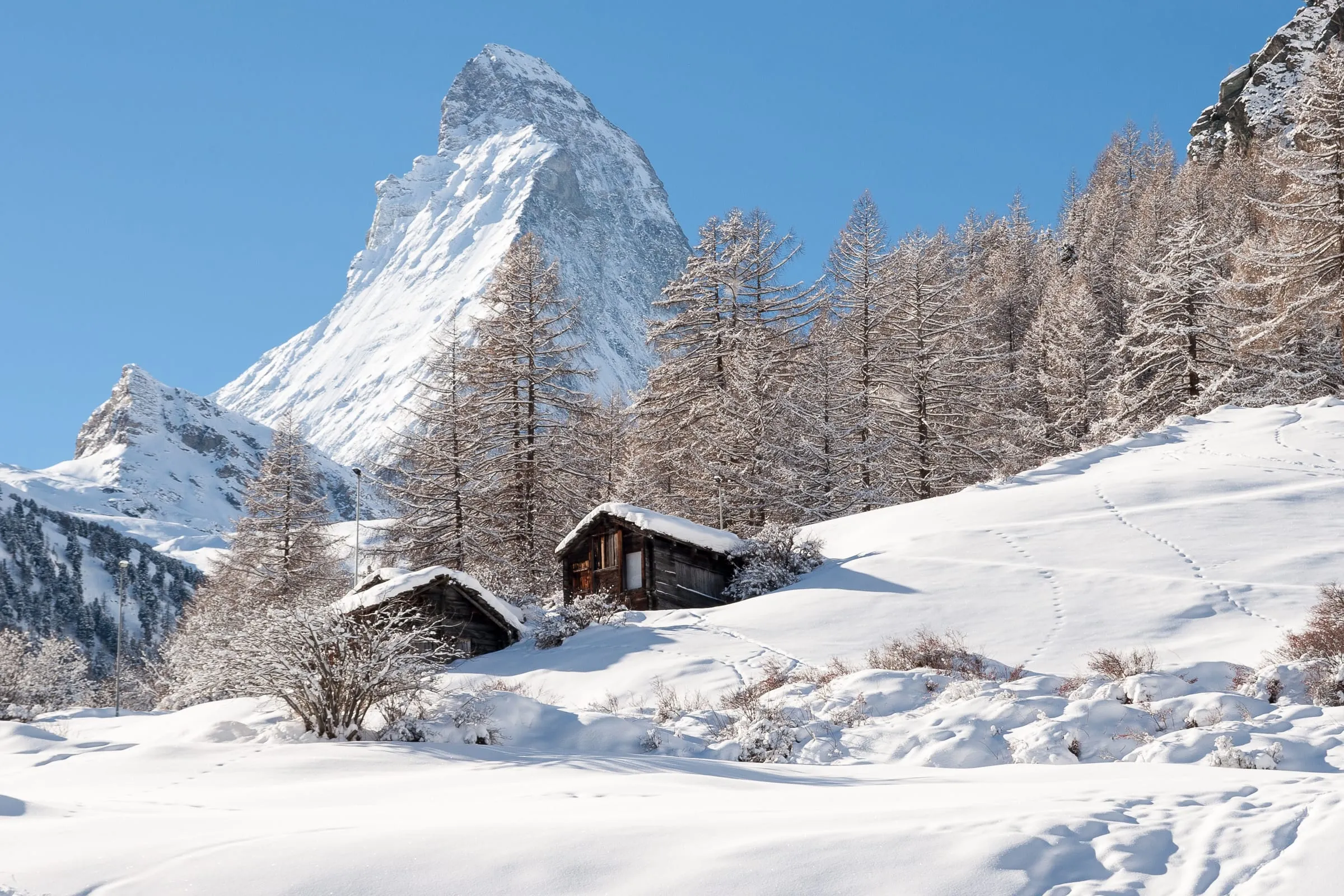
Zermatt sits at 1,608 m at the head of the Mattertal in Valais, and the Matterhorn is never far from view. It’s car-free, it’s a real town rather than a purpose-built resort, and its ski area climbs to 3,883 m at Matterhorn Glacier Paradise. Thanks to that altitude and the glacier, skiing is possible here outside the normal winter season too.
That height is what makes Zermatt one of the safest bets in Europe when snow is thin elsewhere. The other big draw is the link to Italy: one pass gets you over the border to Breuil-Cervinia and Valtournenche.
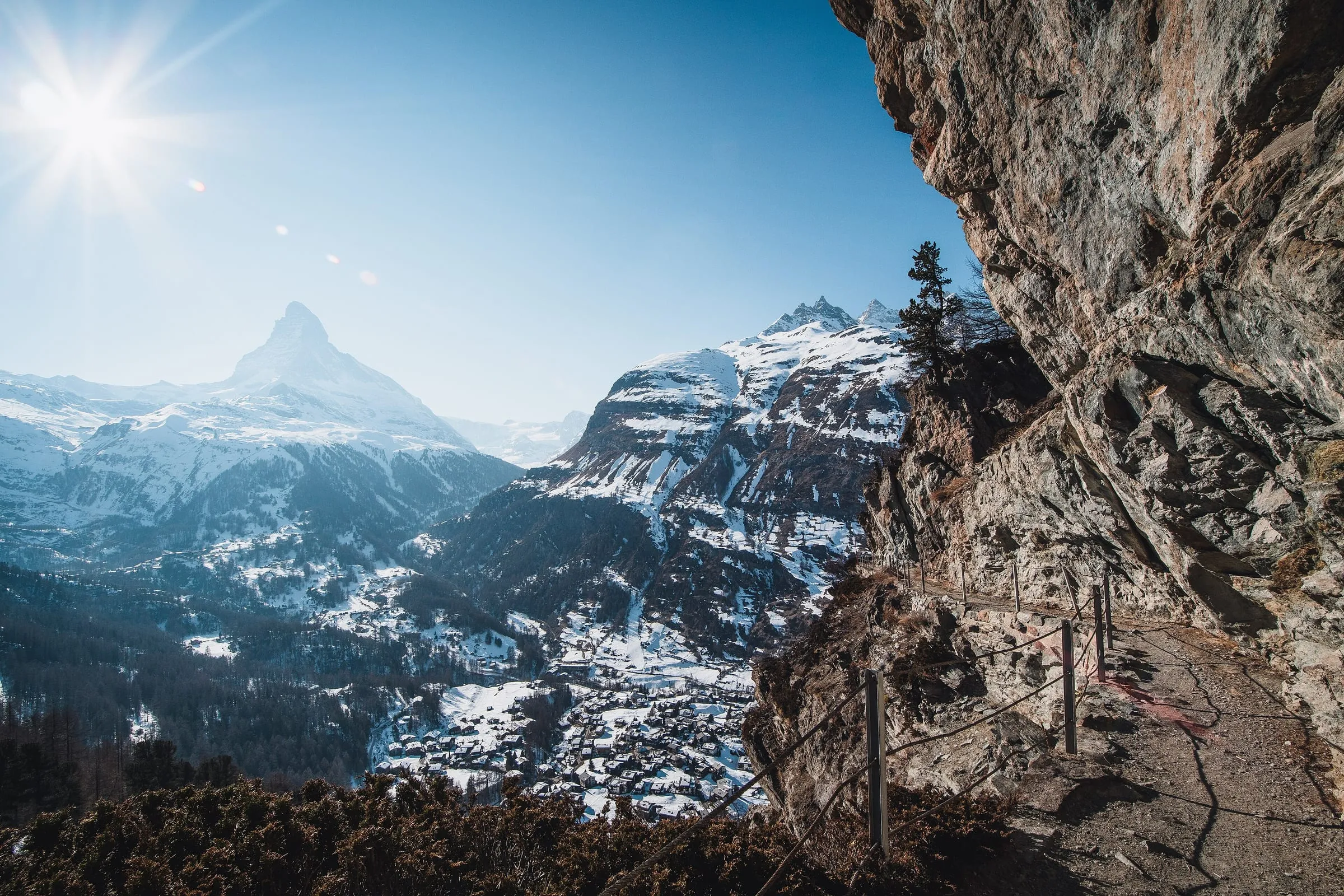
Zermatt ski area: 200 km in Switzerland, 360 km with Italy
Zermatt’s own Swiss slopes add up to about 200 km. Buy the international pass and you can ski over to Breuil-Cervinia and Valtournenche in Italy, for up to 360 km in total. The area is known as the Matterhorn Ski Paradise, and it’s split into separate sectors that you reach by different lifts from different ends of the village:
- Sunnegga, Blauherd and Rothorn: reached by the underground funicular from the village. Sunny, varied runs with classic Matterhorn views, and Wolli’s beginners’ park.
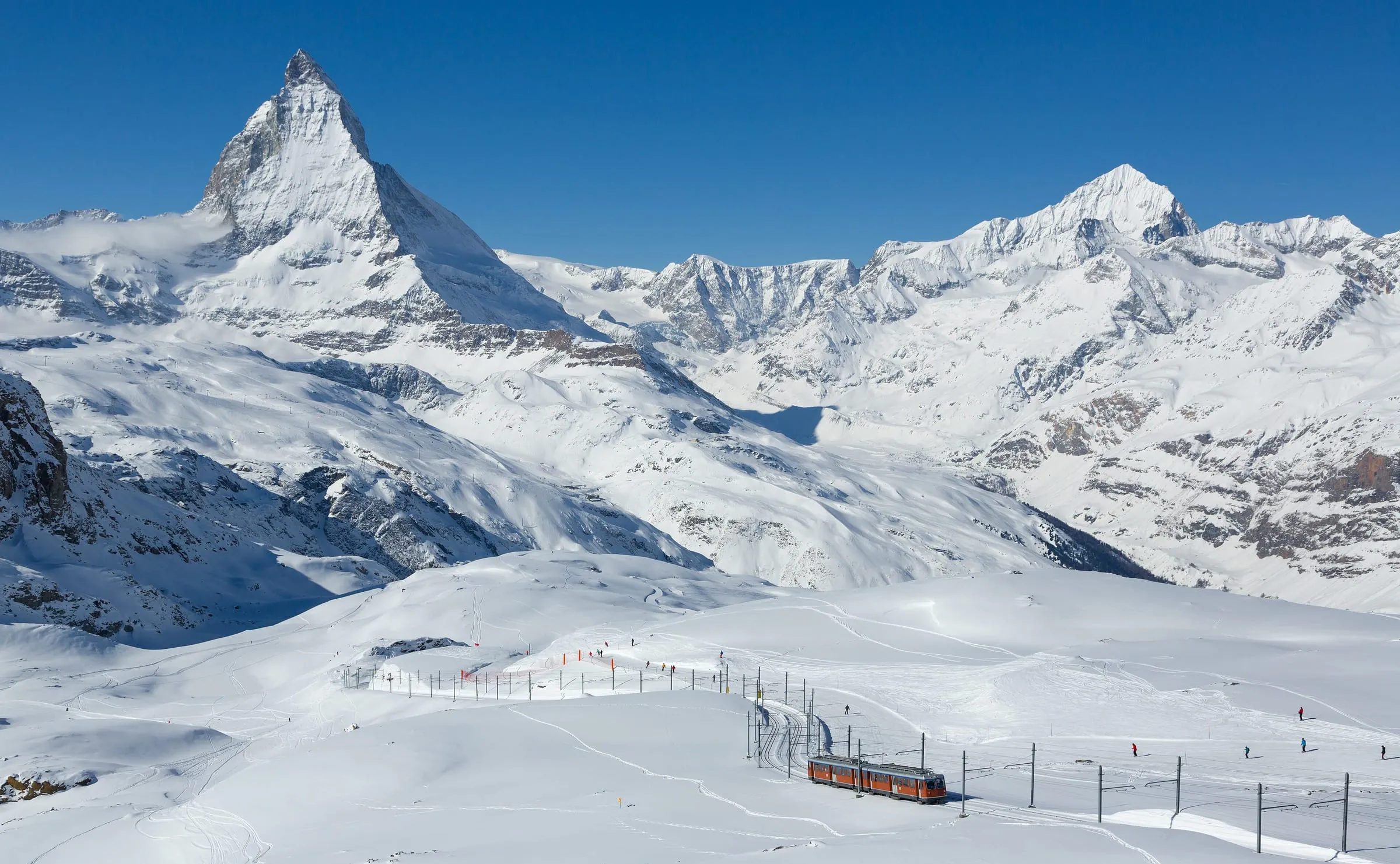
- Gornergrat: reached by rack railway from next to Zermatt station. Long runs below some of Switzerland’s highest peaks. The railway is included in the ski pass, but only for winter sports while the pistes are open.
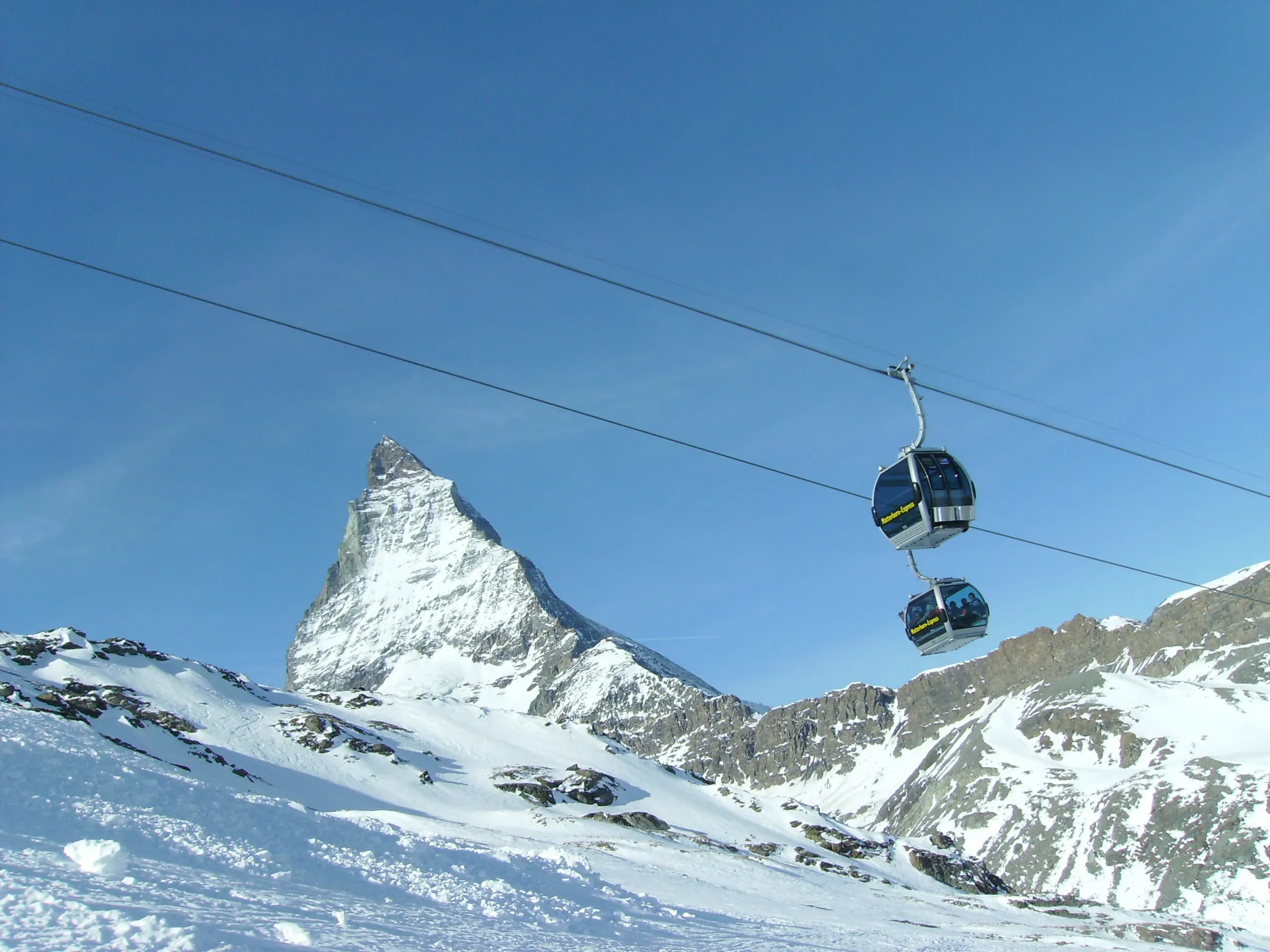
- Matterhorn Glacier Paradise and Schwarzsee: the Matterhorn Express gondola from the south end of the village takes you to the high glacier terrain and the route to Italy.
Getting between sectors takes time, so plan each day around one or two.
Skiing in Zermatt for beginners
Beginners will find suitable slopes and plenty of ski schools, but Zermatt isn’t a resort built around nursery slopes. Wolli’s park at Sunnegga is the place for children’s first turns, and the small lifts at Täsch and Randa, down the valley, are quieter alternatives.
Skiing in Zermatt for intermediates
This is the sweet spot. Long blue and red runs on Sunnegga and Gornergrat, wide glacier pistes on the Theodul Glacier, and the chance of a day trip to Italy. Confident intermediates can ski down to Cervinia for lunch, as long as they watch the clock (see below).
Skiing in Zermatt for experts
Experts get some of the longest descents in the Alps, plus a lot of off-piste with a guide. Zermatt Tourism lists a guided freeride day with the ZERMATTERS guiding company from 14 December 2026 to 30 April 2027. The glaciers make off-piste here genuinely serious: crevasses are a real hazard, so don’t go without a guide.
Matterhorn Glacier Paradise and skiing from Zermatt to Cervinia
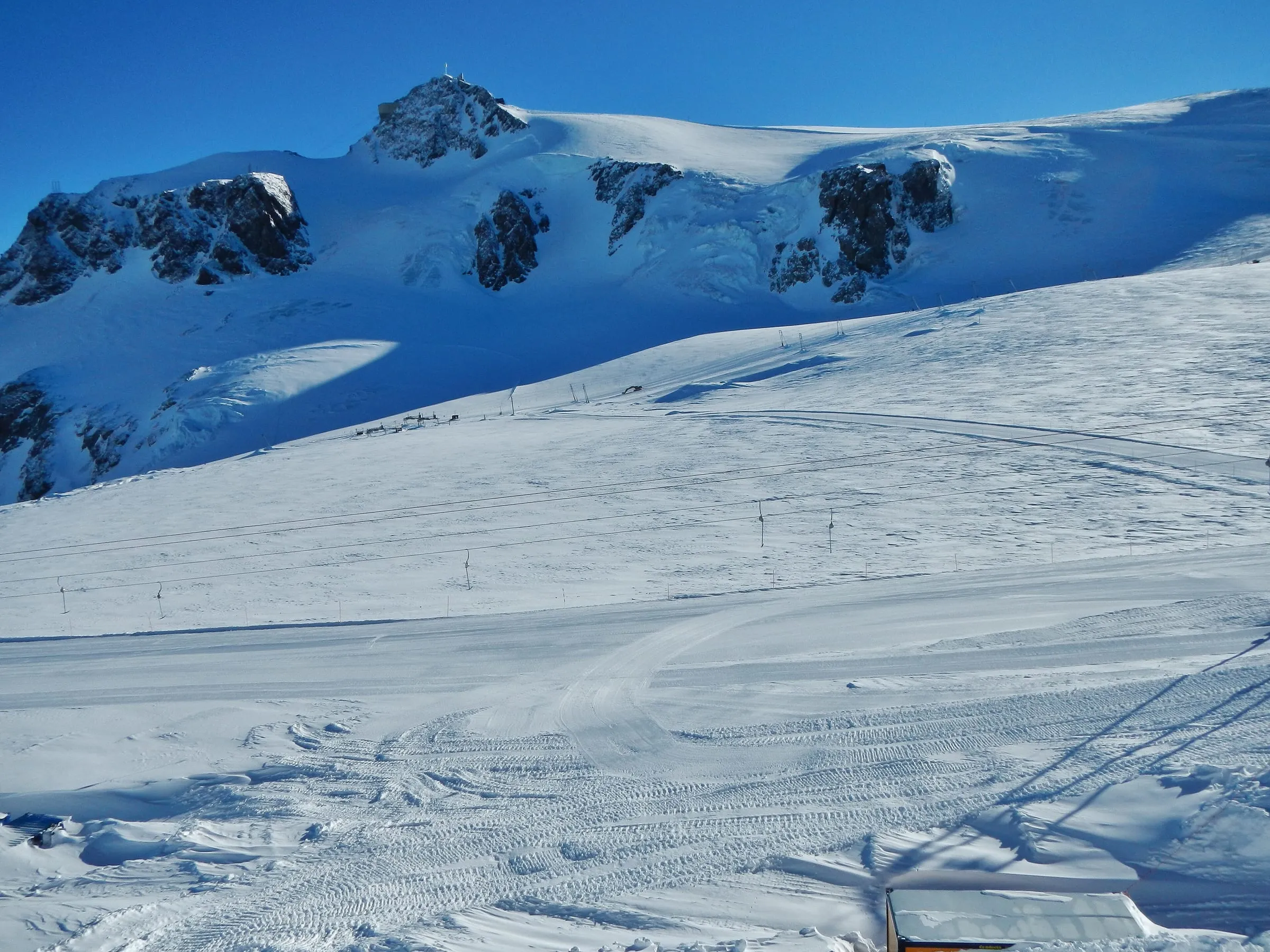
The top of the lift system is Matterhorn Glacier Paradise at 3,883 m. Up there you’ll find the glacier pistes, the panoramic platform and the Glacier Palace, a set of ice tunnels and sculptures inside the glacier. Because of the altitude, skiing is possible here outside the normal winter season.
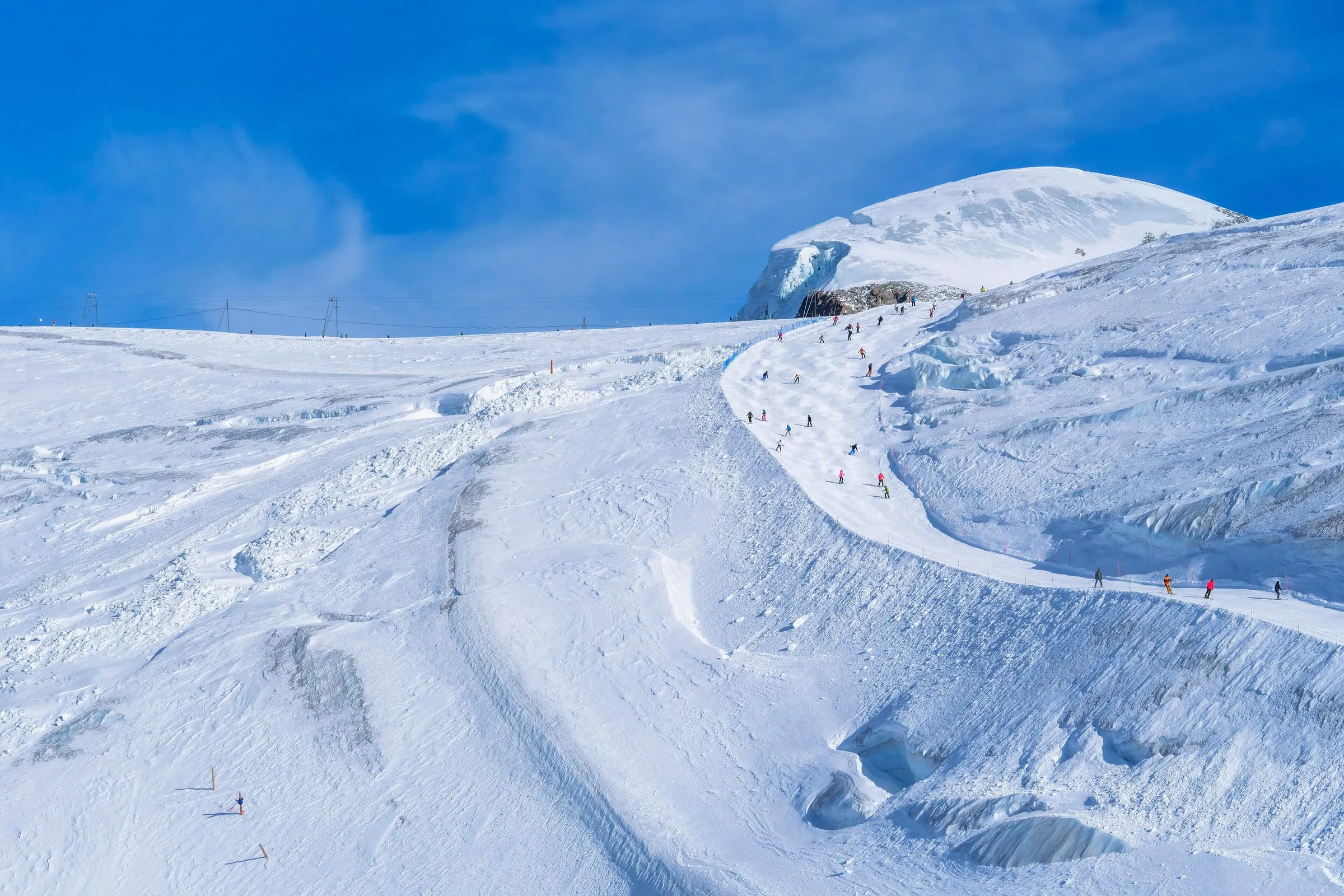
The ski route to Italy crosses the Theodul Glacier and drops down to Breuil-Cervinia. It’s a big day out, and timing matters. In winter 2026/27 the last lift up from Zermatt for Cervinia leaves at 14:50, moving to 15:20 from 30 January 2027. That’s the time to be on the lift in Zermatt; coming back, leave plenty of margin, because missing the last lift home means an expensive taxi round the mountains. Also note that the Testa Grigia to Matterhorn Glacier Paradise lift is closed for maintenance from 7 January to 26 February 2027, so check the lift status before you plan a crossing in that period.
Snow in Zermatt and the 2026/27 season
The winter lift timetable runs from 1 November 2026 to 2 May 2027:
- From 1 November: mainly glacier skiing above Trockener Steg, with the cable cars from Zermatt via Furi to Trockener Steg until the Matterhorn Express takes over.
- From 14 November: the Matterhorn Express gondola runs via Schwarzsee.
- From 28 November: the full timetable on Sunnegga and Gornergrat starts. Some lifts, such as the Kumme gondola, only open from 12 December, and the Hirli and Theodul Express lifts from 19 December, depending on snow.
- From 12 April 2027: the Sunnegga funicular closes for work on its control system, which shuts the Sunnegga and Rothorn sector for the last weeks of the season. The glacier sector keeps running until 2 May.
Over in Italy, Cervinia is open from 24 October 2026 and Valtournenche from 28 November 2026 to 25 April 2027. In summer, the Plateau Rosa summer ski area is due to run from 1 May to 31 October 2027.
The glacier is the safety net when lower slopes struggle. The catch: it’s cold and exposed, and when it closes in wind everyone crowds onto the lower sectors.
Is Zermatt good for a last-minute ski trip?
Yes, more than most resorts, and mainly because of the altitude. With lifts reaching 3,883 m and glacier skiing from 1 November to 2 May, Zermatt is one of the few places in the Alps where you can book a week at short notice and be fairly sure of snow, even in a poor winter.
It’s also easy to reach on the spur of the moment by train: no driving, no chains, no parking. Zurich Airport is about three and a half hours away by rail. The downsides for a last-minute trip are price (it’s one of the most expensive resorts in the Alps) and availability during Swiss and European school holidays. If the weather is stormy, check which sectors are open before you book: when the glacier closes in high wind, you’re down to the lower runs.
When the forecast looks right, find a place to stay in Zermatt.
Zermatt lift passes
- Zermatt pass: covers the Swiss side only.
- International pass: adds Breuil-Cervinia and Valtournenche.
- Children under 9 ski free with the Wolli Card, subject to conditions (an adult has to buy a pass of two days or more). See Zermatt with kids.
- Ikon Pass: Matterhorn Ski Paradise is on the Ikon Pass (7 days on the full Ikon Pass, 5 on Ikon Base), with no need to exchange it first.
Prices vary with the number of days, the area, your age and the travel dates, so check the lift company’s website before you go.
Après-ski and things to do in Zermatt
Zermatt’s après is lively without being rowdy. The best-known stop on the way down is Hennu Stall, on the lower half of the run from Furi back to the village, with DJs and live bands; its listing says it reopens on 4 December 2026. On the Sunnegga side, CERVO Mountain Resort has an après bar at the end of a piste. In the village, the long main street has plenty of bars and restaurants, though eating out is expensive.
Off the slopes there’s the Glacier Palace at 3,883 m, a free ice rink in the village centre (natural and artificial ice, November to mid-March), sledging on the Rotenboden run and the trail at Täsch, and husky sledding.
Who Zermatt suits, and who it doesn’t
- Great for: snow-sure trips early and late in the season, strong skiers who want long runs and guided freeride, intermediates who want to ski into Italy, rail travellers, and anyone who wants a proper car-free village with the Matterhorn on the doorstep.
- Think twice if: you’re on a tight budget, you want ski-in/ski-out convenience as standard, you’re a nervous beginner who wants a compact nursery area, or you want to drive right up to your hotel.
Skiing with children? Read our guide to Zermatt with kids.
How to get to Zermatt
By train
The train is the natural way in. Change at Visp onto the Matterhorn Gotthard Bahn, which runs every half hour up the Mattertal to Zermatt station, right in the car-free village centre. Visp is on both the main line along the Rhône valley from Geneva and Lausanne and the line from Bern. Zermatt Tourism gives door-to-door times of about three and a half hours from Zurich Airport and about four hours from Geneva or Basel airports. You can send luggage ahead with the SBB luggage service.
By car
You can’t drive into Zermatt. Private cars, electric ones included, may only go as far as Täsch, and driving on without a permit brings heavy fines. From the Rhône valley, turn off at Visp and follow the Mattertal road up to Täsch. Park at the Matterhorn Terminal Täsch (2,100 covered spaces) and take the shuttle train: every 20 minutes, 12 minutes to Zermatt. Private car parks in Täsch add more than 1,000 spaces, and taxis are an alternative.
From northern Switzerland, the Lötschberg car train from Kandersteg to Goppenstein runs every 30 minutes and takes about 15 minutes. Most high passes are closed in winter, including the Grimsel, Furka and Nufenen. The Simplon from Italy is normally kept open, but check conditions before you set off.
You need a Swiss motorway vignette (CHF 40), either as an e-vignette or a sticker. The 2026 vignette is valid until 31 January 2027, and the 2027 one from 1 December 2026. Switzerland has no general legal requirement for winter tyres, but if your car isn’t properly equipped for winter you can be held liable after an accident, and your insurer may pay less. Fit winter tyres and carry chains: you must use them where signs say so.
Nearest airports
Zurich, Geneva and Milan Malpensa are the main airports. From Zurich and Geneva the train is the simplest transfer, with a change at Visp.